QEEG brain map is a non-invasive assessment that measures the electrical activity in your brain and creates a visual map showing how different regions are functioning. Think of it like a weather map for your brain, instead of showing temperature and precipitation, it reveals patterns of brainwave activity that can help identify areas of concern and guide treatment for conditions like ADHD, anxiety, depression, and cognitive decline.
Understanding QEEG: The science behind brain map
QEEG stands for Quantitative Electroencephalogram. While that sounds technical, the concept is straightforward. Your brain constantly generates electrical signals as billions of neurons communicate with each other. These signals create brainwaves that operate at different speeds depending on what you’re doing, whether you’re sleeping, concentrating, or feeling anxious.
A QEEG captures these brainwave patterns using sensors placed on your scalp. The ‘quantitative’ part means the raw data is analyzed using sophisticated software and compared against a database of healthy brain patterns. This comparison reveals whether certain areas of your brain are over-active, under-active, or not communicating efficiently with other regions.
Unlike a standard EEG that simply records brainwave activity, a QEEG processes that information and translates it into color-coded brain maps. These maps make it easy to see exactly where imbalances exist, information that’s invaluable for understanding symptoms and creating targeted treatment plans.
What happens during a QEEG brain map session
The QEEG process is completely painless and non-invasive. Here’s what you can expect:
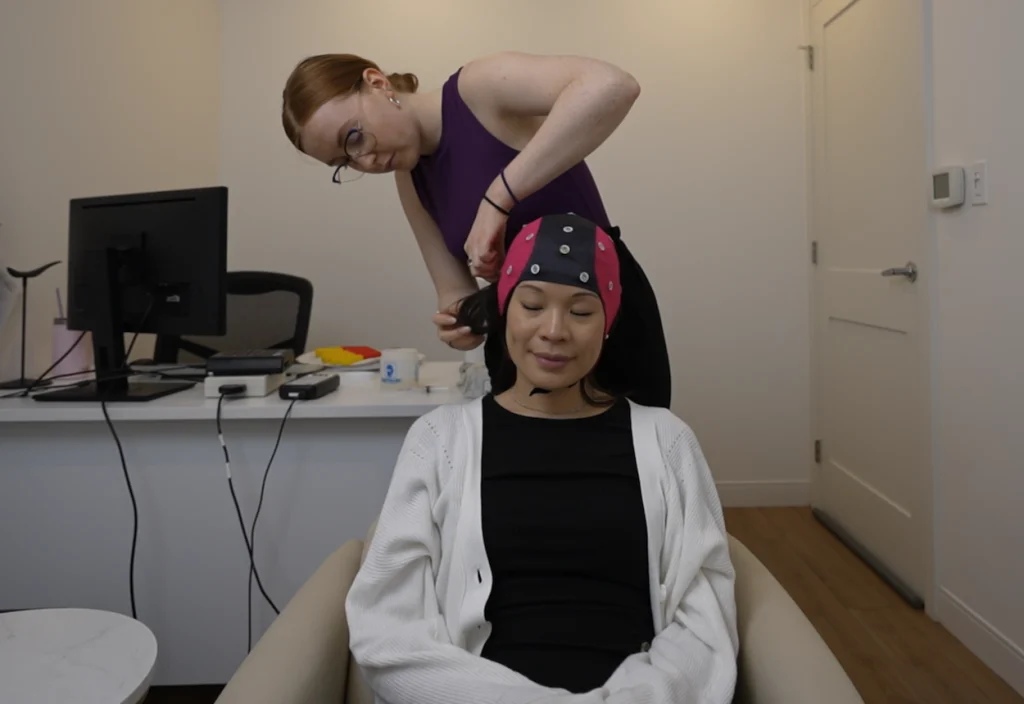
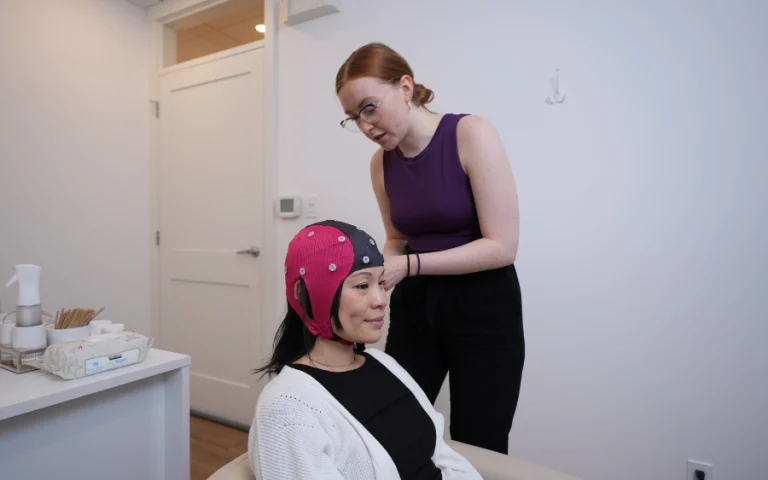
You’ll sit comfortably in a chair while a technician places a cap fitted with sensors on your head. These sensors detect electrical signals from your brain, they don’t send anything into your brain, they only listen. A small amount of conductive gel helps ensure clear readings.
The actual recording takes about 30-45 minutes. During this time, you’ll go through different conditions: sitting quietly with your eyes closed, with your eyes open, and sometimes performing simple cognitive tasks like sadness and happiness. These different states help capture a complete picture of how your brain functions across various activities.
The raw data is then processed using specialized software that analyzes the brainwave patterns and generates the visual brain maps. A trained clinician reviews these maps to identify patterns associated with specific conditions or symptoms.
What QEEG brain map reveals
QEEG doesn’t diagnose conditions on its own, but it provides objective data that illuminates what’s happening in your brain. Here’s what it can reveal:
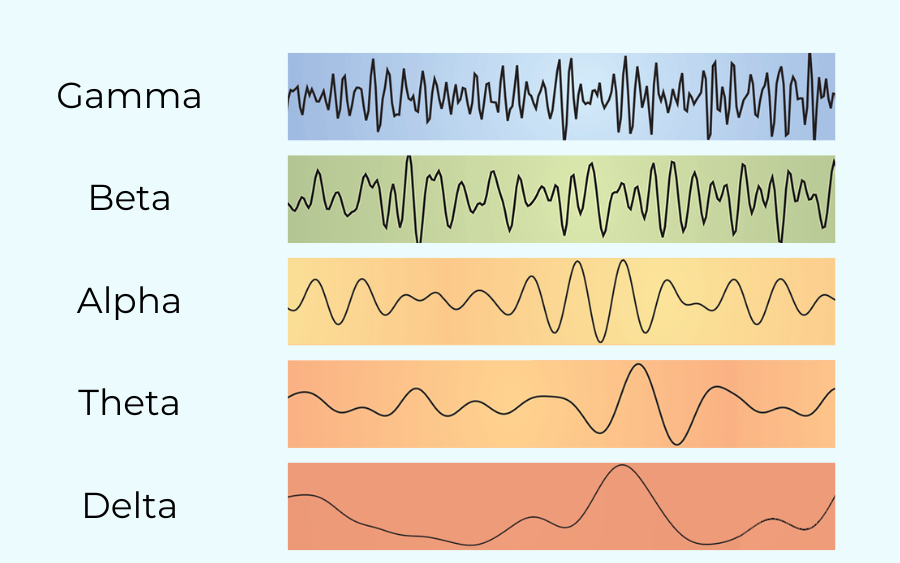
Brainwave Imbalances – Your brain produces different types of brainwaves, delta, theta, alpha, beta, and gamma, each associated with different states of consciousness and mental activities. A QEEG shows whether you have too much or too little of any brainwave type in specific regions.
For example, someone with ADHD often shows excess theta waves (slow waves associated with daydreaming) in areas responsible for attention and focus. Someone with anxiety might show excessive beta waves (fast waves) in regions that should be calmer.
Connectivity Issues – Brain regions need to communicate efficiently. A QEEG can identify areas that aren’t connecting well with each other, like having a conversation where some words are getting lost. Poor connectivity between the frontal lobes and other regions, for instance, can affect executive function, emotional regulation, and decision-making.
Regional over-activity or under-activity – The maps show whether specific brain regions are working too hard or not hard enough. Someone experiencing depression might show reduced activity in the left frontal region, an area associated with positive emotions and motivation. Conversely, someone with obsessive thoughts might show over-activity in areas involved in repetitive thinking patterns.
Why QEEG matters for treatment
Understanding your specific brain patterns changes everything about treatment. Rather than trying different medications or therapies through trial and error, clinicians can use QEEG data to create targeted interventions.
This is particularly relevant for neurofeedback training, a type of therapy that teaches your brain to create healthier patterns. With a QEEG map as a guide, neurofeedback protocols can be customized to address your exact imbalances. If your brain is producing too many slow waves in attention areas, neurofeedback can train it to increase faster, more focused waves in those regions.
QEEG can also inform decisions about other treatments like TMS (Transcranial Magnetic Stimulation), medication management, and even lifestyle interventions. It removes guesswork and replaces it with personalized, brain-based information.
Who benefits from QEEG brain map
QEEG is valuable for anyone wanting to understand their brain function better, but it’s particularly helpful for people experiencing:
- ADHD and attention difficulties: Reveals patterns of distraction, impulsivity, and executive function challenges
- Anxiety and panic disorders: Shows areas of over-arousal and stress response patterns
- Depression and mood disorders: Identifies regions with reduced activity linked to low motivation and negative thinking
- Sleep problems: Reveals abnormal patterns that interfere with healthy sleep-wake cycles
- Cognitive decline and memory issues: Detects slowing of brainwaves and connectivity problems associated with aging
- Concussion and brain injury: Identifies lingering effects on brain function even after physical healing
- Peak performance goals: Athletes, executives, and students use QEEG to optimize focus and mental performance
QEEG vs. other brain imaging
People sometimes confuse QEEG with MRI or CT scans, but they measure completely different things.
An MRI or CT scan shows brain structure, the physical anatomy of your brain. These are essential for detecting tumors, bleeding, or structural abnormalities. However, they can’t tell you how your brain is functioning electrically.
QEEG measures brain function, the electrical activity and communication patterns. You could have a perfectly normal MRI but still have significant functional issues that show up clearly on a QEEG. Think of it this way: an MRI shows you the hardware, while QEEG shows you the software running on that hardware.
The research behind QEEG
QEEG isn’t new or experimental. It’s based on decades of research and thousands of studies. Large databases containing brainwave patterns from healthy individuals across different ages allow for accurate comparisons.
Research has identified characteristic QEEG patterns associated with ADHD, anxiety disorders, depression, learning disabilities, and many other conditions. While individual brains vary, these patterns are consistent enough to provide meaningful clinical information.
Organizations like the International Society for Neurofeedback and Research (ISNR) and the American Academy of Pediatrics have recognized QEEG as a valuable assessment tool. It’s used in clinics, hospitals, and research institutions worldwide.
Limitations and what QEEG can’t do!
It’s important to understand what QEEG is and isn’t. QEEG is an assessment tool, it provides information that helps guide treatment decisions. It doesn’t diagnose medical conditions on its own. A comprehensive evaluation includes clinical interviews, symptom assessments, medical history, and sometimes other testing alongside QEEG data.
QEEG also captures brain activity at a specific moment in time. Factors like caffeine, stress, medication, or poor sleep can influence results, which is why clinicians look at patterns rather than single data points.
Finally, QEEG requires skilled interpretation. The maps are only as useful as the clinician’s ability to understand what they reveal and translate that into effective treatment plans.
How brain-based therapy can help
At Elumind, QEEG brain map is the foundation of our approach to mental health and brain performance. We use detailed brain maps to understand exactly what’s happening in your brain, then create personalized treatment plans that address your specific patterns.
Our services include neurofeedback training, which uses the insights from your QEEG to retrain brainwave patterns toward healthier functioning. We also offer biofeedback for stress and anxiety, TMS therapy for depression, and cognitive training programs, all informed by objective brain data.
Whether you’re struggling with attention problems, anxiety, mood issues, or simply want to optimize your brain performance, QEEG brain map gives us a roadmap to help you get there more efficiently. Learn more about our QEEG brain map service or explore our neurofeedback therapy options.
Taking the next step
If you’re curious about what’s happening in your brain and how that information could guide more effective treatment, a QEEG brain map might be the answer you’ve been looking for.
Elumind offers comprehensive QEEG brain map with detailed interpretation and personalized treatment recommendations. We have clinics throughout BC including North Vancouver, Surrey, and Kelowna.
Book a free consultation to learn more about QEEG and whether it’s right for you. Visit elumind.com/booking or call us at (604) 220-8866. We’re here to help you understand your brain and find the most effective path to feeling better.





 Phone: (604) 220-8866 |
  Monday—Friday: 9:00 AM-7:30 PM