

If your child has been diagnosed with ADHD, you’ve likely been told that medication is the first-line treatment. And you might be wondering: is medication the only option? What about alternatives? Is there a way to help my child that doesn’t involve daily pills?
These are questions we hear from parents every week. The decision about how to support a child with ADHD is deeply personal, and there’s no single right answer for every family. Some children do well with medication. Others experience side effects, or their parents prefer to explore non-pharmaceutical approaches first. Many families want to understand all their options before deciding.
This guide will help you understand both medication and neurofeedback for ADHD, what the research says, how they work differently, and what factors to consider as you make decisions for your child.
How ADHD medication works
Stimulant medications like Ritalin, Concerta, Vyvanse, and Adderall are the most commonly prescribed treatments for childhood ADHD in Canada. These medications increase dopamine and norepinephrine levels in the brain, neurotransmitters that help with focus, impulse control, and executive function.
For many children, medication provides rapid symptom relief. Within 30-60 minutes of taking a stimulant, parents often notice their child can sit still longer, follow instructions more easily, and complete homework with less frustration. This quick action is one of medication’s biggest advantages, when it works, it works fast.
However, medication comes with considerations that matter to many families:
- Side effects: Common ones include appetite suppression, sleep difficulties, mood changes, headaches, and stomach aches. Some children experience emotional blunting or personality changes that concern parents.
- Daily management: Medication must be taken every day (sometimes multiple times per day), which can be challenging for families and stigmatizing for children who need to take pills at school.
- Temporary effects: Medication manages symptoms while active in the system but doesn’t create lasting changes in brain function. When medication is stopped, symptoms typically return.
- Trial and error: Finding the right medication and dosage often requires weeks or months of adjustment, during which your child may experience different side effects.
- Not effective for everyone: Research shows that approximately 20-30% of children don’t respond well to stimulant medication, and another group cannot tolerate the side effects.
None of this means medication is wrong or bad. For many families, it’s been life-changing. But it’s also completely reasonable to want to understand other approaches, especially ones that might create more lasting changes in how your child’s brain functions.
How neurofeedback works for ADHD
Neurofeedback is a completely different approach. Instead of using chemicals to temporarily alter brain activity, neurofeedback trains the brain to regulate itself more effectively, and those changes can be lasting.
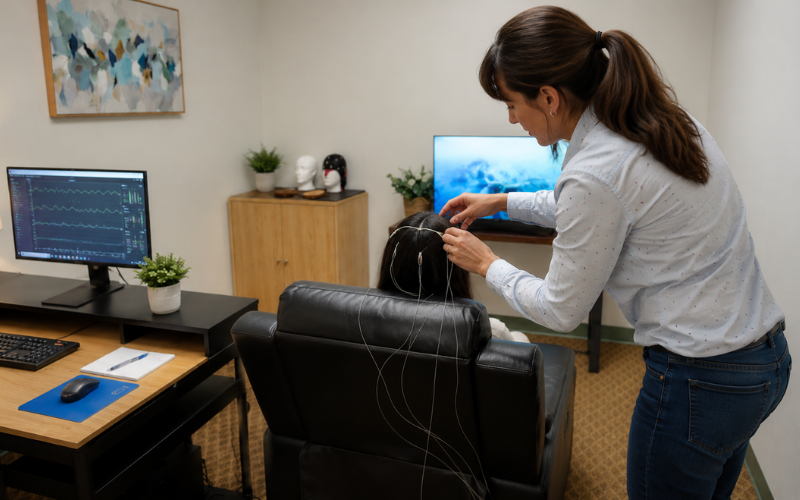
Here’s what happens during a neurofeedback session: Your child sits comfortably while wearing sensors on their scalp that measure brainwave activity (this is completely non-invasive and painless, nothing goes into the brain). They then watch a movie. When their brain produces the healthier patterns we’re targeting, the movie plays smoothly. When their brain slips into less optimal patterns, the feedback pauses or dims slightly.
This creates a learning process. Session by session, your child’s brain learns to produce more focused, regulated patterns and fewer of the scattered, impulsive patterns associated with ADHD. It’s like physical therapy for the brain, strengthening the neural pathways that support attention, self-control, and emotional regulation.
Key differences from medication:
- Creates lasting change: Neurofeedback teaches the brain new patterns that persist after treatment ends. Research shows that improvements are typically maintained long-term.
- No side effects: Because nothing is being added to the body, no medication, no electrical stimulation, there are no pharmaceutical side effects. Some children feel tired after early sessions as their brain adjusts, but this passes quickly.
- Addresses root patterns: Rather than managing symptoms, neurofeedback targets the underlying brainwave dysregulation that causes ADHD symptoms.
- Gradual improvement: Unlike medication’s rapid action, neurofeedback improvements build over weeks. Parents typically notice changes around session 10-20, with continued progress through 30-40 sessions.
- Non-invasive and drug-free: This matters to families concerned about long-term medication use in developing brains, though both approaches have strong safety profiles.
What does the research say?
Both medication and neurofeedback have substantial research support for treating ADHD, though medication has been studied longer and more extensively.
Medication effectiveness: Stimulant medication is effective for approximately 70-80% of children with ADHD, with effect sizes (a measure of treatment impact) typically ranging from 0.7 to 1.0, considered moderate to large in clinical research.
Neurofeedback effectiveness: Multiple meta-analyses (studies that combine results from many smaller studies) have found neurofeedback effective for ADHD, with lasting improvements in attention, hyperactivity, and impulsivity. A 2016 study in European Child & Adolescent Psychiatry found effect sizes comparable to medication for core ADHD symptoms. A 2019 meta-analysis in Clinical Neurophysiology confirmed significant improvements across multiple neurofeedback protocols.
Importantly, research shows neurofeedback improvements are maintained at 6-month and 12-month follow-ups, whereas medication effects end when the prescription stops.
The American Academy of Pediatrics gave neurofeedback a “Level 1 – Best Support” efficacy rating for ADHD in 2012, the same rating given to medication. This reflects decades of research showing real, measurable benefits.

Can neurofeedback and medication be combined?
Absolutely. Many families use both approaches together, and this can be an excellent strategy.
Some parents choose to start neurofeedback while their child is on medication, then gradually reduce medication as brain training takes effect (always under their prescribing doctor’s supervision). Others use medication for immediate symptom management at school while building lasting change through neurofeedback. Some find that neurofeedback allows their child to take a lower medication dose while maintaining the same benefits.
At Elumind, we work collaboratively with your child’s physician, psychiatrist, or pediatrician. We’re not asking you to choose between approaches, we’re offering an additional tool that addresses ADHD from a different angle.
Which approach is right for your child?
There’s no universal answer. The right choice depends on your child’s specific situation, your family’s values, and practical factors like time and resources.
Medication might be the right starting point if:
- Your child is struggling significantly at school and needs rapid symptom relief
- You want to see quick results to determine if symptom improvement helps your child academically and socially
- Time constraints make twice-weekly neurofeedback appointments difficult
- Your child has tried other treatments without significant improvement (this is uncommon but does happen)
Neurofeedback might be worth exploring if:
- Your child has tried medication but experienced side effects you’re not comfortable with
- You’re concerned about long-term medication use and want to build skills that last beyond treatment
- Your child is opposed to taking daily medication (this matters, treatment works better when kids are on board)
- You want an approach that addresses underlying brain patterns rather than managing symptoms
- Your child has tried medication without satisfactory results
- You prefer non-pharmaceutical approaches when effective alternatives exist
Many families ultimately find that a combination approach works best, or they transition from medication to neurofeedback once brain patterns have stabilized.
What to expect with neurofeedback at Elumind
If you’re considering neurofeedback for your child, here’s what the process looks like:
We begin with the therapeutic assessment and a qEEG brain map, a detailed assessment that shows exactly how your child’s brainwave patterns differ from typical patterns for their age. QEEG Brain Map looks like a colorful brain scan, shows us precisely where dysregulation is occurring and helps us design a personalized training protocol.
Training typically involves 2-3 sessions per week for 12-16 weeks. Each session lasts about 45-50 minutes. Your child sits comfortably watching a movie or YouTube kids they enjoy while sensors read their brainwave activity. There are no uncomfortable procedures, most kids find it relaxing.
Parents usually notice initial changes around session 10-20: their child might start completing homework more independently, respond less impulsively when frustrated, or have an easier time transitioning between activities. Improvements continue building through the full training program.
After completing neurofeedback, most children maintain their improvements long-term. We typically recommend a follow-up qEEG brain map 6-12 months after training to confirm that positive patterns have stabilized.
The most important thing: You’re not alone!
Parenting a child with ADHD comes with difficult decisions, and the pressure to choose the “right” treatment can feel overwhelming. Please know there’s no wrong choice here, both medication and neurofeedback help thousands of children every year. What matters most is that you’re informed, that your child is involved in decisions as appropriate for their age, and that you choose an approach that aligns with your family’s needs and values.
At Elumind, we’re not here to pressure you toward any particular decision. We’re here to give you accurate information, answer your questions honestly, and support your family whether you choose neurofeedback alone, medication alone, or a combination of approaches.
If you’d like to learn more about whether neurofeedback might benefit your child, we offer a free 15-minute consultation where you can ask questions and discuss your child’s specific situation. We can also schedule a qEEG brain map to show you exactly what’s happening in your child’s brain and what neurofeedback could target.
You can book online at elumind.com/booking or call our team at (604) 220-8866. We have clinics across BC (North Vancouver, Surrey, and Kelowna) and provide the same evidence-based care at every location.
Whatever you decide, you’re already doing the most important thing: seeking the best possible support for your child. That’s what good parenting looks like.




 Phone: (604) 220-8866 |
  Monday—Friday: 9:00 AM-7:30 PM